944 Turbo (951) Frequently Asked Questions
Comprehensive FAQ covering the 944 Turbo (951): model history, differences from the 944, turbocharger and boost control system operation, and diagnosis of common problems.
1.0 Introduction
The 944 Turbo — factory designator 951 — made its international debut at the Geneva Auto Show in March 1985. Approximately 176 cars were released for the European market in 1985, with the first US cars arriving in the 1986 model year. Even before the Geneva debut, a pre-production 944 Turbo competed at and won the 24-hour endurance race at Nelson Ledges in June 1984.
2.0 Differences Between the 944 and 944 Turbo
2.1 Foreword
The comparisons in this section apply primarily to the 1985 and 1986 944 Turbos as compared to 944s built up to that time. Later 944 models were equipped with much of the same equipment as their 944 Turbo counterparts.
2.2 Engine
The 944 Turbo engine retained the same 2.5 L2.6 qt displacement as the 944. The addition of a KKK K-26 #6 turbocharger, along with other supporting modifications, yielded significant performance gains.
| 1985 911 Carrera | 1985 928S | 1985 944 | 1985 944 Turbo | |
|---|---|---|---|---|
| Displacement | 3164 cc | 4957 cc | 2479 cc | 2479 cc |
| Horsepower (SAE) | 200 | 288 | 143 | 217 |
| Torque (SAE ft-lb) | 185 @ 4800 | 302 @ 2700 | 137 @ 3000 | 243 @ 3500 |
| 0–60 mph | 6.3 sec | 6.1 sec | 8.3 sec | 6.1 sec |
| Top Speed (mph) | 146 | 155 | 130 | 152 |
| Fuel Economy — City | 17 mpg | 17 mpg | 23 mpg | 21 mpg* |
| Fuel Economy — Highway | 25 mpg | 28 mpg | 36 mpg | 33 mpg* |
*Estimated figures at the time of release. Numbers originally published in the March 1985 issue of Panorama. Note: the 0–60 mph figure for the 944 Turbo was actually a 0–100 kph time of 6.3 seconds; the 6.1 sec figure comes from an additional source and is included for reference.
Unlike the 924 Turbo, the turbocharger on the 944 Turbo was moved to the opposite side of the engine from the exhaust. This reduced turbocharger inlet temperatures by approximately 160 °F. The turbocharger also has a water-cooled bearing housing. During normal operation, cooling water is supplied from the engine cooling system via a tap on the low-temperature side of the radiator. The cooling water returns to the water pump suction via a small thermostat, or to the expansion tank if the thermostat is closed. During shutdown, coolant is supplied from the radiator and expansion tank, circulated through the bearing housing, and returned to the expansion tank; the water in the expansion tank is cooled by being siphoned through the makeup line to the radiator. Coolant circulation through the bearing housing is supported by an electric pump. This combination of lower inlet temperatures and water cooling dramatically increased turbocharger life expectancy over the 924 Turbo and 911 Turbo.
The 951 cylinder head received several modifications. The exhaust ports have ceramic liners cast into them, which results in higher exhaust temperatures and better turbo response. Although this may seem to contradict moving the turbocharger away from the exhaust side of the engine, the ceramic liners insulate the ports so that exhaust energy is retained in the gases and converted into work in the turbine rather than being lost as rejected heat into the cylinder head. An additional benefit is a reduction in the heat load on the cooling system. The 944 Turbo also uses sodium-filled valves for better heat dissipation.
An intercooler reduces charge air temperature by approximately 135 °F to provide a denser air charge. Because of the increased engine performance, the engine also received thicker cylinder walls, forged pistons, a larger oil pump, and a heavier head gasket. 944 Turbos were equipped with an external oil cooler; the 944 has the cooler integral to the block.
2.3 Transaxle
The 944 Turbo received a transaxle with a different gear ratio from the 944 and employed an external oil cooler. A transaxle with limited slip differential and external oil cooler was also available as optional equipment. Gear ratios:
| 1986 944 (ROW) 016J | 1986 944 (US/Japan) 016K | 1986 944 Turbo 016R | |
|---|---|---|---|
| 1st Gear | 3.6000 | 3.6000 | 3.5000 |
| 2nd Gear | 2.1250 | 2.1250 | 2.0588 |
| 3rd Gear | 1.4583 | 1.4583 | 1.4000 |
| 4th Gear | 1.0714 | 1.0714 | 1.0345 |
| 5th Gear | 0.8286 | 0.7297 | 0.8286 |
| Reverse | 3.5000 | 3.5000 | 3.5000 |
| Final Drive | 3.8890 | 3.8890 | 3.3750 |
2.4 Body
The 944 Turbo introduced body changes that carried over to later water-cooled models. Most noticeable is the aerodynamic front end, which integrates fog lights and front bumper into a single panel. The panel includes ducts for engine cooling air flow. The 944 Turbo has a larger frontal silhouette than the 944 (1.89 m² vs. 1.82 m²), but the smoother lines produce a lower drag coefficient (0.33 vs. 0.35). In addition to the rear hatch spoiler, the 944 Turbo carries an underside rear bumper spoiler — airflow between the body and this spoiler creates negative lift, improving stability at speed. The 951 also has side skirts at the bottom of the rocker panels.
2.5 Suspension, Brakes, and Wheels
The 944 Turbo front brakes have a smaller surface area per wheel than the 944 (86 cm² vs. 92 cm² per wheel). The rear uses the same pad on both models, but the 944 uses a smaller pad (63 cm² per wheel). Total brake area: 344 cm² (turbo) vs. 310 cm² (944). The 944 Turbo uses 4-piston fixed caliper brakes while the 944 uses single-piston floating calipers. Both models use vented rotors.
The 951 came equipped with 16" cast aluminum wheels (7J × 16 front, 8J × 16 rear) with 205/55 VR 16 front and 225/50 VR 16 rear tires. Forged aluminum wheels were available as a factory option. Standard on the 944 was 7J × 15 wheels with 205/60 VR 15 tires; 7J × 16 forged alloy wheels (same as 911) with 205/55 VR 16 tires were optional.
Stabilizer bar sizes: 944s used 20 mm front bars as standard (rear bars optional at 14 mm), and were also available with 21.5 mm solid or 23 × 3.5 mm tubular front stabilizers; 944 rear torsion bars were 23.5 mm. 951s came with 22.5 mm front and 18 mm rear stabilizers, and 23.5 mm torsion bars; tubular front stabilizers (24 × 3.7 mm) were also available for the turbos. Through mid-1985.5, 944s had steel control arms; later models and all 951s used light alloy control arms.
2.6 Interior
There is essentially no difference between the 944 and 944 Turbo interiors. The only noticeable addition is a boost gauge beneath the tachometer.
3.0 Model Year Differences
3.1 Foreword
The following covers changes to the 944 Turbo by model year.
3.2 1987 Model Year
Minor engine modifications for 1987 include the change from an eccentric roller cam belt tensioner to a spring tensioner — a change also made on the 944. An oil level sending unit was added to the oil pan, illuminating a low oil level warning light on the dash. The oil pressure relief valve changed from a three-piece unit (1986) to a one-piece unit. New timing covers were produced as a result of the spring tensioner and water pump pulley changes.
Beginning in 1987, the 944 Turbo transaxle came without an external oil cooler as standard equipment, though the cooled transaxle and the LSD-with-cooler unit remained available as options.
ABS was offered as optional equipment on both the 944 and 944 Turbo. This required the wheel offset to increase from 23.3 mm to 52.3 mm — all cars received the increased offset wheels regardless of ABS fitment. Tubular front stabilizers (25.5 mm × 4 mm) were used.
The M030 suspension option became available in 1987. With M030: front tubular stabilizer increases to 26.5 mm × 4 mm, height-adjustable Koni yellow struts (standard cars used FS black struts through the end of the 1988 model year), and harder rubber strut bearings identifiable by a green stripe on the underside. Spring rate for cars without M030: 21.8 N/mm, unsprung length 251 mm (through end of 1988 MY). M030 spring rate: 28 N/mm, unsprung length 220 mm.
For the rear suspension through the end of 1988, FS grey shock absorbers were standard equipment; Koni yellows were optional. With M030, Koni yellow shocks have two white dots offset 180°, and torsion bar size increases to 25.5 mm.
The 1987 944 Turbo was the first production car in the world to be equipped with driver and passenger side air bags as standard equipment. On the 944 that year, the driver's air bag was standard and the passenger's was optional. A low oil level warning light was added to the dash, and a 180 mph speedometer replaced the 170 mph unit used on the 1986 model Turbos.
3.3 1988 Model Year
No significant changes were made until mid-1988. One minor change was the DME chip arrangement: 1986–87 cars have a DME with a 24-pin chip; from 1988 onward, a 28-pin chip was installed. The 1988 DMEs received the same map as the early cars; the extra 4 pins were reportedly never used.
In mid-1988, Porsche introduced the 944 Turbo S (engine designation M 44.52). The initial limited production run consisted of approximately 750–1000 cars, all finished in Silver Rose Metallic exterior with burgundy plaid cloth interior.
The Turbo S engine remained essentially unchanged from the early 1988 models, but the turbocharger was changed to a K-26#8. It is electronically limited to the same maximum boost (1.75 bar25 psi) as the earlier cars, and both achieve maximum boost at approximately 3000 rpm. However, the K-26#8 maintains maximum boost through 5800 rpm, while the earlier K-26#6 drops from 1.75 bar25 psi at 3000 rpm to 1.52 bar22 psi at 5800 rpm. This produced a 30 hp increase in peak horsepower and a 15 ft-lb increase in peak torque.
| 944 Turbo (M 44.51) | 944 Turbo S (M 44.52) | |
|---|---|---|
| Horsepower | 217 HP @ 5800 rpm | 247 HP @ 6000 rpm |
| Torque | 243 ft-lbs @ 3500 rpm | 258 ft-lbs @ 4000 rpm |
| 0–60 mph | 6.1 sec | 5.5 sec |
| Top Speed | 152 mph | 162 mph |
The Turbo S transaxle came standard with a limited slip differential. The LSD inner plates are 2.5 mm thick (vs. 2.0 mm on earlier models), requiring the two thrust rings to be 0.5 mm thinner to maintain the same overall thickness. Inner plates and differential shafts are molybdenum-coated for additional hardness. The clutch uses a two-stage torsional spring damper, with friction material both bonded and riveted to the disc (earlier cars used rivets only).
Turbo S wheels: milled forged 7J × 16 front and 9J × 16 rear (52.3 mm offset), with 225/50 VR 16 front and 245/45 VR 16 rear tires. M030 suspension package, ABS, and limited slip differential were all standard equipment on the Turbo S.
3.4 1989/1990 Model Year
Few changes were made for 1989 and 1990. 1990 was the last year the 944 Turbo was imported to the United States, with fewer than 150 cars imported that year.
The primary difference between 1989/1990 cars and the Turbo S was wheel sizing. 1989 models retained 7J × 16 and 9J × 16 wheels with the same cutout size as the Turbo S wheels, but the offset changed to 65 mm front and 60 mm rear. An alternate wheel option used a smaller cutout: 7J × 16 front (65 mm offset) and 8J × 16 rear (52.3 mm offset). For 1990: 7.5J × 16 (65 mm offset) front and 9J × 16 (52.3 mm offset) rear.
3.5 1991 Model Year
The 944 Turbo ended production in 1991 with the introduction of the 944 Turbo Cabriolet in the first half of that model year. Approximately 875 cars total were produced in 1991, of which approximately 525 were cabriolets, with 255 exported outside Germany.
The open body required additional chassis stiffening. Together with the electric top motor, the Cabriolet is 110 lbs heavier than the Coupe — though this did not significantly affect performance. The windshield was lowered 2.4 inches and raked rearward 0.6 inches to reduce wind noise with the top down.
The top is raised by electric motors but must be latched by hand using two handles in the cassette storage bin. Wheels: 17" shod with 225/50 and 245/45 tires. M030 suspension, ABS, and limited slip differential were all standard equipment.
Community note: Most of the above information on the 944 Turbo Cabriolet is drawn from period automotive press coverage. The figure of approximately 875 total 1991 cars is sourced from the 924/944/968 FAQ and may vary.
4.0 Turbocharger and Boost Control System Operation
4.1 Foreword
This section covers the turbocharger and boost control system as documented in the 944 Turbo Workshop Manual and period technical sources.
4.2 Turbocharger
The stock 944 Turbo uses a KKK K-26#6 turbocharger for 1986–1988 models (engine M 44.51) and a K-26#8 for 1988.5–1991 models (engine M 44.52). For KKK turbochargers, the first number designates compressor housing size (K-26) and the second designates turbine ("hot house") size (#6 or #8). The larger turbine of the K-26#8 maintains maximum boost longer, producing higher peak torque and horsepower.
The turbocharger is supplied from the car's exhaust via an insulated two-to-one crossover pipe. Exhaust headers are also insulated to retain exhaust energy. On the intake side, air flows from a plastic pipe connected to a pocket in the left fender well, through the air filter housing, through a "barn door" type airflow sensor, and via a rubber inlet plenum boot to the turbocharger compressor. The compressor discharge goes through an air-to-air intercooler mounted under the nose panel between the headlights, then back to the throttle body at the intake manifold.
4.3 Wastegate
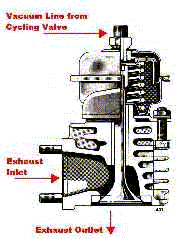
The wastegate performs two functions: it limits turbocharger speed to protect itself from over-spinning, and it limits boost pressure to protect the engine. When the wastegate opens, it bypasses part of the exhaust flow around the turbocharger turbine, limiting both turbine speed and boost pressure.
The 944 Turbo uses an external wastegate. It is attached to a collector pipe that taps off the crossover pipe from the exhaust headers. The wastegate discharge line taps into the exhaust just downstream of the catalytic converter and contains a small catalytic converter.
The wastegate valve is similar to a cylinder head intake or exhaust valve. The valve stem is threaded into a spring-loaded diaphragm that sits on top of the wastegate body. Spring pressure pulls upward on the valve stem to hold it against its closed seat. Exhaust pressure enters the body from the stem side and works to push the valve off its seat. The top of the diaphragm assembly contains a chamber with a pressure line connected to a solenoid boost control valve — the cycling valve.
4.4 Cycling Valve
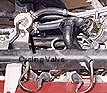
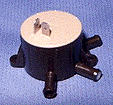
The cycling valve is located beneath the intake manifold. It has three ports: one connected to the turbocharger inlet (between the airflow meter and turbocharger), one to the turbocharger discharge via a banjo bolt on the intercooler pipe, and one to the wastegate diaphragm.
Normally the cycling valve is "open," allowing pressure from the turbocharger discharge to bleed back to the turbocharger inlet through an orifice. When moving toward the "closed" position, the cycling valve closes the port to the turbocharger inlet, allowing pressure from the turbocharger outlet to pass through to the wastegate diaphragm. When the combined pressure on top of the diaphragm and exhaust pressure against the valve seat overcome the spring pressure, the wastegate opens — bypassing exhaust flow around the turbocharger and limiting boost.
The cycling valve is controlled by the KLR Unit (Knock Regulator Unit). The KLR receives signals directly and from the DME Control Unit to determine how the cycling valve should be controlled. When boost reaches the preset limit, the KLR signals the cycling valve to close. If the cycling valve fails, loses power, or the KLR has a problem, the cycling valve defaults to fully closed — limiting boost to approximately 1.2 bar17 psi (the pressure at which exhaust force alone overcomes the wastegate spring).
5.0 Common 944 Turbo Questions
5.1 What does the boost gauge reading on my dash mean?
The 944 Turbo boost gauge reads the absolute pressure on the car's intake manifold. This means the gauge indicates both boost pressure and intake manifold vacuum when off boost. When the gauge reads less than 1 bar15 psi, there is a vacuum in the intake manifold and the turbocharger is not providing forced flow. Above 1 bar15 psi, the turbo is providing positive forced air flow. By comparison, the 911 Turbo boost gauge reads gauge pressure — it only indicates when the turbo is on boost.
5.2 What is the maximum boost I should see?
The factory shop manual clearly states that the maximum boost for both M 44.51 and M 44.52 engines is 1.75 bar25 psi:
"Maximum boost pressure of 1.75 bar25 psi (absolute pressure) is reached at approximately 3,000 rpm. At higher engine speeds (engine type M 44.51) the boost pressure drops off again and reaches a boost pressure of 1.52 ±0.03 bar0 psi (absolute pressure) at 5,800 rpm. With engine type M 44.52, the boost pressure remains constant at 5,800 rpm (1.75 bar25 psi absolute pressure) and drops only after this value has been passed."
- M 44.51 — 1986–1988 944 Turbos
- M 44.52 — 1988.5–1991 944 Turbos
The factory indicates a 10% tolerance at maximum indicated boost, meaning the indicated maximum could range from 1.58 bar23 psi to 1.93 bar28 psi. Begin investigating if maximum boost is consistently below 1.6 bar23 psi.
Community note: There has been debate among owners about whether the later M 44.52 cars produce a higher maximum boost than the M 44.51 cars. The factory specification is 1.75 bar25 psi for both.
5.3 I hear a humming noise under the hood after I turn the ignition off. Is that normal?
The noise is the turbocharger cooling pump. It should run every time the ignition is switched off. The pump also responds to a temperature sensor in the turbo cooling water outlet line. The pump relay has a timer that runs the pump for 30 seconds after shut-off regardless of temperature.
6.0 944 Turbo Problems
6.1 Foreword
This section covers problems that 944 Turbo owners have experienced. Much of this information was originally compiled for the 944 Turbo Problems FAQ, developed by Chris Mellor with contributions from Jim Dresser, Chris Hanlon, Clark Archer, Farzaan Kassam, Bob Tucker, and many others.
6.2 Turbo Does Not Boost Correctly
Symptoms:
- Boosts to a level and will not go higher
- Produces no turbo pressure at all
- Produces varying boost depending on the gear selected (see section 6.2.5 for the kinked throttle cable problem)
Diagnostic procedure: Clamp off the line from the cycling valve to the wastegate and drive the car. This closes the wastegate and directs all exhaust to the turbine. Drive above 3000 rpm but do NOT fully depress the throttle — if boost is present with the cycling valve line clamped but not otherwise, the problem lies in the cycling valve/wastegate control circuit. This could mean the cycling valve is receiving bad information from a faulty DME, knock sensor, or control unit, or is faulty itself.
Warning: Do not fully depress the throttle with the wastegate clamped closed — the turbo can over-speed and over-boost the engine, causing damage.
If the car still does not boost with the line clamped, check for:
- Mechanical turbocharger failure
- Leak or problem in the air intake system
- Wastegate stuck open
- Exhaust system leak
- Other mechanical problems
- Engine computer problems
Additional diagnostic checks:
- If boost is limited to 0.2 bar3 psi or 1.2 bar17 psi absolute, suspect a connection problem on one of the sensors (TPS, airflow meter, etc.)
- Install an aftermarket boost gauge to measure what the turbo is actually producing. A slipping clutch can absorb all turbo boost and make it seem as if the turbo is not working. An aftermarket gauge measures boost pressure before the intercooler.
6.2.1 Mechanical Turbo Problems
Pull off the turbo intake hose and check for free movement of the compressor wheel. The compressor wheel itself may be damaged.
6.2.2 Air Intake Problems
Look for vacuum leaks — any vacuum leak becomes a boost leak once the turbo spools up.
- Check all vacuum lines for cracking, corrosion, or brittleness.
- Check along the intake manifold between the pressure side of the turbo and the inlet manifold.
- Check rubber Y-connectors on the intake manifold.
- Inspect the rubber boot on the intercooler pipes.
- Check the rubber boot from the turbo to the metal intercooler pipe.
- Check the compressor bypass valve (air cut-off valve) located on the rubber boot just before the throttle body. A vacuum line runs to the top of it. If the valve fails stuck open, boost from the turbo will re-circulate and never reach the engine.
Testing the timing valve (cycling valve): The valve is located between cylinders 3–4, just under the intake manifold, and has three hoses and an electrical connector (white top). With the engine running, place a stethoscope on top of the valve and quickly throttle the car past 60% — listen for a rapid clicking ("blap/blap/blap"). The valve is controlled by the KLR.
An intercooler blocked or full of oil can also limit boost.
Note: Leaks in the inlet manifold area should trigger a blink code. Very small leaks may allow pressure to escape without registering a code. To confirm the blink code system itself works, a specialist can force a fault — for example, removing the throttle connector should start the code blinking; if it does, the KLR is at least partially functional.
Even a tiny crack in the inlet piping can reduce boost to nothing. Make sure the intercooler is not split, corroded, or cracked.
6.2.3 Wastegate Problems
With the car idling, the wastegate bypass pipe should be cold or only slightly warm. Use a hand vacuum/pressure pump to check wastegate operation.
Apply no more than 0.5 bar7 psi (approximately 7 lbs) of pressure to the wastegate — higher pressure can damage the diaphragm.
Warning: Do not start the engine with any exhaust components disconnected.
- If the bypass pipe warms up, the wastegate is working.
- If the bypass pipe is hot at idle without pressure applied, the wastegate is stuck open.
- Check that the wastegate is not stuck open.
- Check the vacuum hose from the rear of the engine to the wastegate for leaks.
- Check that the wastegate hose is the correct size — an oversized hose can leak and cause erratic wastegate behavior.
6.2.4 Exhaust System Leaks
Use a hose-type stethoscope to check for exhaust leaks from the header. Check for cracks in the turbo's exhaust housing. If a catalytic converter is fitted, verify it is not clogged.
6.2.5 Other Mechanical Problems
A kinked throttle cable can prevent the turbo from spooling properly. One documented case produced 2 bar29 psi at full throttle in first gear but no boost in second through fifth; the fault worsened as the car warmed up.
A faulty throttle position switch (located on the throttle body, forward of the intake manifold) can also prevent proper turbo spooling. The connector to this switch is prone to corrosion; temporarily moving the connector may restore function, but disassembling, cleaning, and applying dielectric grease is the proper fix.
If the timing belt has slipped a tooth, the engine timing will be retarded and boost may be reduced.
An oil trap leak can drop boost.
Check the cycling valve connections. Corroded or broken connections result in a maximum of 0.2 bar3 psi (1.2 bar17 psi absolute) with no error codes.
6.2.6 Engine Computer Problems
The 944 Turbo is controlled by a Bosch Motronic DME unit linked to a KLR turbo control unit. If either is faulty, boost may be affected. A Bosch diagnostic unit can be connected to the DME to retrieve fault codes.
DME units can malfunction due to broken solder joints or broken/bent pins in the wiring connector.
Community note: New replacement and reconditioned DME units are available from Porsche specialists and independent rebuilders.
6.3 More Pronounced Turbo Lag
Check the vacuum pipe connecting to the top of the air recirculating valve (also called the blow-off or pop-off valve). A failed valve can cause this pipe to be blown off, eliminating the valve's function.
The air recirculating valve prevents a sudden slowdown of the turbocharger compressor wheel when the throttle is released. When the throttle closes, intake manifold vacuum signals the valve to open, recirculating compressed air back to the turbocharger inlet and maintaining compressor wheel speed. Without it, the compressor wheel decelerates and must re-spool on the next acceleration — causing lag.
The air recirculating valve is located on top of the large-diameter ribbed plastic pipe between the airflow meter and the turbocharger inlet. The vacuum pipe runs between the valve and a T-piece near the regulator valve on the front of the fuel rail.
Testing the valve:
- Remove it by releasing two hose clamps and pulling off the vacuum pipe.
- Blow hard into each air connection while feeling for leaks at the other connections.
- There should be no leaks — leaks indicate a failed internal diaphragm.
6.4 Turbo Overboosts
Symptoms: Boost builds normally, then fuel cuts off abruptly at approximately 4000 rpm. Or: boost rises to approximately 1.8 bar26 psi, then the car jerks hard and power drops suddenly.
These are overboost situations. When the DME/KLR detects overboost, it cuts fuel to protect the engine.
Common causes:
- Cracked pressure line to wastegate: A crack in the rubber hose leading to the wastegate will cause overboost. Inspect this hose carefully — it can dry-rot over time.
- Broken vacuum/boost line to KLR: The hose between the intake manifold (between cylinders 3 and 4) and the KLR control unit in the passenger footwell. If this hose is cut or leaking, the KLR reads atmospheric pressure and goes into overboost protection mode.
- Dirty airflow meter connector: Clean the connector on the airflow meter.
- Stuck wastegate: If the wastegate is stuck closed, boost will build uncontrolled until the DME/KLR cuts fuel.
- Leaks in lines to wastegate or cycling valve: If the wastegate cannot measure correct boost pressure, it will not regulate properly.
Inspect all hoses to and from the wastegate and cycling valve.
6.5 Turbo Cooling Pump/Fan Failure
Symptom: The turbo water pump does not run after the engine is shut off.
The turbo water pump should run for approximately 30 seconds after shut-off, independent of coolant temperature. Failure to run shortens turbocharger life.
Diagnosis:
- Disconnect the wires from the pump and apply direct battery voltage — if the pump does not run, replace it.
- If the pump runs with direct voltage, check the relay (G19 on an 1986 944 Turbo; G22 on later models).
- It is also possible that the pump is mechanically binding — loosening the hoses and adjusting the pump position may free it.
Community note: Replacement turbo water pumps are available. Replacing the pump along with all connected hoses is recommended at the same time.
6.6 Fitting an Aftermarket Boost Gauge
Option 1: There is a banjo bolt on the intake manifold just above and slightly forward of the cycling valve (between cylinders 3 and 4, round, approximately the size of a half-dollar). This banjo bolt has a vacuum line with a T or Y connector. Replace the T/Y connector with a 4-way X connector and route the gauge line to the new port.
Option 2: Tap into the vacuum line from the intake manifold to the KLR control unit using a T connector. This minimizes the vacuum line length and avoids routing through the firewall. A 1/4" compression fitting works for the 944 Turbo vacuum line, though it requires care to install the compression nut and ferrule. Most aftermarket boost gauge kits include 1/8" hard plastic tubing with a compression fitting.
Caution: When tightening the compression nut for 1/8" tubing, use care — the 1/8" ferrule crushes easily.
6.7 Turbo Pump Stays On When Engine Running
Symptom: After washing the engine compartment, the turbo pump runs continuously whenever the car is started.
Diagnosis: Water may have damaged the thermo-switch for the pump. The switch is mounted in the turbo water pipe and has a single wire connector with black Bakelite covering. To test: disconnect the switch — if the turbo water pump does not immediately start when the ignition is turned on (without starting the engine), the switch is faulty.
6.8 Random Boost Fall to 1.2 bar17 psi
Symptom: Intermittently, the turbo boosts only to 1.2 bar17 psi instead of the normal maximum. Restarting the engine clears the problem.
Possible causes:
- Throttle position sensor fault. The intermittent nature and the fact that restarting clears the problem is consistent with a TPS issue.
- Fuel delivery problems (failing fuel pressure regulator, vacuum leak affecting fuel enrichment).
- Exhaust system condition, loose turbocharger connections.
The fault may be intermittent enough that it does not appear during a shop diagnostic session.
Known solution: In one documented case, the fault was traced to a failed KLR chip.
Community note: The above diagnoses represent community troubleshooting experience and may not cover all cases. A comprehensive inspection — including dyno testing with exhaust gas analysis — can help isolate intermittent faults.
6.9 Excessive Heat from Intake Manifold
Symptom: After turbo removal and reassembly, the intake manifold becomes extremely hot (too hot to touch after shutdown) despite normal coolant temperature. The DME may richen the mixture in response.
Diagnosis: Suspect the thermo-switch for the turbo cooling pump. The switch is in the turbo water pipe and has a single wire connector with black Bakelite covering. To test: disconnect the switch — if the turbo water pump does not immediately start when the ignition is turned on (without starting the engine), the switch is faulty.
6.10 Turbo Oil Leak
Symptom: Oily smell from exhaust during moderate-to-hard acceleration (no visible smoke); brief oil smoke on first rev after overnight storage; oil deposits throughout the intercooler piping.
The presence of oil throughout the intercooler and piping suggests a turbocharger shaft seal leak. This is particularly suspected when:
- The oil is not coming from the crankcase breather (confirmed by temporarily capping the breather)
- Leak-down test results are normal
- Valve guides and seals have been recently serviced with no improvement
- The problem has gradually worsened over time
A worn turbocharger shaft seal is the most likely cause in this scenario. Turbocharger rebuild or replacement should be considered.
Community note: This is a problem statement without a confirmed diagnosis in the original source. If you have confirmed resolution of a similar issue, the procedure may differ.
6.11 Cycling Valve Not Receiving Signal from Computer
Symptom: The cycling valve tests good mechanically, but receives no signal from the engine management. The valve should respond when the airflow sensor flap opens past 60°. Wiring and the pressure line to the valve appear intact.
Possible causes beyond a failed computer include faults in the sensor inputs feeding the KLR (knock sensor, throttle position sensor, airflow meter). However, no definitive diagnostic procedure is documented here.
Community note: This is a problem statement without a confirmed resolution in the original source.
6.12 Turbo Oil Consumption
Symptom: Oil consumption increases significantly with hard driving — as much as 1 quart per 600 miles vs. 1 quart per 3000 miles under light use. Car overboosts as well.
Higher oil consumption under boost is related to turbocharger seal condition and engine wear. With overboost also present, the combined problems suggest investigation of both the turbocharger and the boost control system.
Community note: This is a problem statement without a confirmed diagnosis in the original source.
6.13 Oil in the Intercooler
A light film of oil on the inner surfaces of the intercooler and connecting pipes is normal. Over time this film builds up and can reduce intercooler efficiency. The intercooler should be cleaned periodically as oil accumulation increases.
Heavy oil accumulation or oil pooling at low points indicates a more significant turbocharger seal leak and should be investigated further.
6.14 Boost Rises Then Power Falls
Symptom: As the throttle is depressed, boost rises as expected, but just as it should produce a power surge, power actually drops — similar to an unexpected downshift. The boost gauge reads positively but performance is missing.
Diagnosis: The most likely cause is the DME/KLR detecting an overboost condition and cutting fuel. The actual boost may not be reaching the intake manifold despite the gauge reading. Checks to perform:
- Unplug the airflow meter connector and clean it.
- Check for disconnected or kinked vacuum hoses.
- Check the idle speed screw.
- Inspect the wastegate for being stuck closed.
- Verify the timing valve has power and is functioning.
Community note: This problem can result from several interacting faults; diagnosis may require systematic elimination. At least one owner spent considerable time and visited multiple mechanics before resolving the issue. If straightforward checks do not resolve it, further professional diagnosis is warranted.