Cooling Fan Troubleshooting — Late Cars
How the dual-fan cooling system works on late cars (1985.5 and later, including all Turbos), with a symptom-to-cause guide and relay, thermofan-switch, and motor test procedures.
COOLING FAN TROUBLESHOOTING
PORSCHE 944 · LATE CARS
Pick the symptom you have to start the diagnosis.
Cooling Fan Operation
Late cars use a similar slow-speed resistor arrangement, but there are two resistors — one for each fan motor. Both fans run (rather than just the driver's side) when the thermofan switch closes on high coolant temperature, even with the ignition off.
The thermofan switch on late cars is a dual-element switch: one contact closes at 92 °C198 °F for slow-speed operation, and a second contact closes at 102 °C216 °F to bypass the slow-speed resistors (fast speed). Slow-speed operation is available regardless of ignition switch position; fast-speed operation requires the ignition to be on.
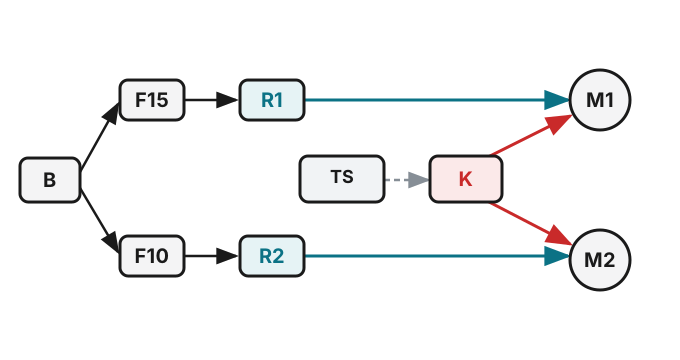
Late circuit: (B) battery feed · (F10/F15) fuses · (TS) dual-element thermofan switch — contact at 92 °C198 °F (slow) and 102 °C216 °F (fast) · (K) cooling-fan relay · (R1/R2) the two slow-speed resistors · (M1/M2) the two fan motors.
Cooling Fan Troubleshooting
Identify the symptom you are seeing, then jump to the likely cause below.
Note: This guide assumes a single failure is causing the fault. Multiple simultaneous failures can occur, but covering every combination is impractical — diagnose one cause at a time.
Blown fuse
One or more fans will not run. Fuse 10 — Cooling Fan 2; Fuse 15 — Cooling Fan 1. If neither fan runs, it is unlikely both fuses blew simultaneously.
Bad fan motor
One or more fans will not run. Disconnect the connector and take resistance readings. Infinite resistance or a ground indicates a bad motor. It is highly unlikely for both motors to fail simultaneously.
Bad slow-speed resistor
Fans will not run in slow speed (they still run in fast speed). Locate the slow-speed resistors in the passenger's footwell behind the glove box (on the underside of the battery tray). Resistance should be less than 1 ohm. It is highly unlikely for both resistors to fail simultaneously.
Bad cooling fan relay
Fans will not run, will not run in fast speed, or run continuously with the ignition OFF (disconnect the thermofan switch connector — if the fans do NOT stop, the relay is most likely bad). See Testing the Cooling Fan Relay.
Bad thermofan switch
Both fans run continuously with the ignition OFF — disconnect the thermofan switch connector; if the fans stop, the switch is bad. Even with a bad thermofan switch, the fans should still run in slow speed when the A/C is on. See Testing the Thermofan Switch.
Testing the Cooling Fan Relay
Tools needed:
- Multimeter
- Electrical jumper
Procedure:
- Ensure the A/C switch is in the OFF position.
- With the ignition off, disconnect the thermofan switch connector (below the upper hose connection at the radiator).
- Jumper terminals 2 and 3 on the thermofan switch connector. Both fans should start in slow speed.
Note: The terminals on the thermofan switch connector are not numbered. Determine terminal numbers by the orientation of the tab on the plug connector — see the connector diagram below.
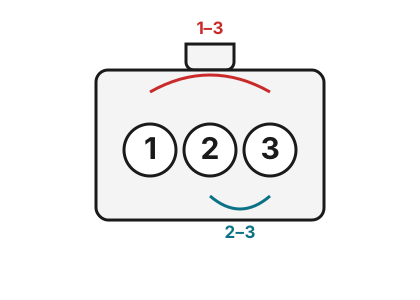
Thermofan switch connector (viewed into the plug): the locating tab fixes orientation. Terminals 2–3 = slow-speed contacts; terminals 1–3 = fast-speed contacts.
- With the jumper still installed, turn the ignition ON. Fans should remain in slow speed.
- Turn the ignition OFF and swap the jumper to terminals 1 and 3.
- Turn the ignition ON. Both fans should run in fast speed.
- Turn the ignition OFF and remove the jumper.
- Turn the ignition ON and switch A/C ON. Both fans should run in slow speed.
- If the relay fails any of the tests above, it is bad and should be replaced.
Testing the Thermofan Switch
The late cars thermofan switch is a dual-element switch: one contact closes at 92 °C198 °F (slow speed) and a second contact closes at 102 °C216 °F (fast speed). The bench test watches for contact closure at each setpoint.
Note: The original procedure documented a bench test only for the early single-element switch. The setpoints (92 °C198 °F / 102 °C216 °F) are from the factory description above; the two-stage method below applies the same approach to the late dual-element switch.
Tools needed:
- Thermometer (rated to at least 110 °C230 °F)
- Multimeter
Procedure:
- Connect a multimeter across the slow-speed contacts on the thermofan switch. At room temperature, contacts should be open (infinite resistance).
- Suspend the thermofan switch in a pan of water. Insert the thermometer to monitor temperature.
- Heat the water. When temperature reaches 92 °C198 °F, the slow-speed contact should close (zero resistance on multimeter).
- Move the multimeter to the fast-speed contacts and continue heating. When temperature reaches 102 °C216 °F, the fast-speed contact should close (zero resistance on multimeter).
Repairing Fan Relays
If the cooling fan relay is confirmed bad, inspect it before purchasing a replacement. Like many electronic components on the 944, the fan relay is susceptible to cracked solder joints. Open the relay and inspect the board with a magnifying glass — cracks will be approximately the width of a human hair. If any joint looks suspect, re-solder it.
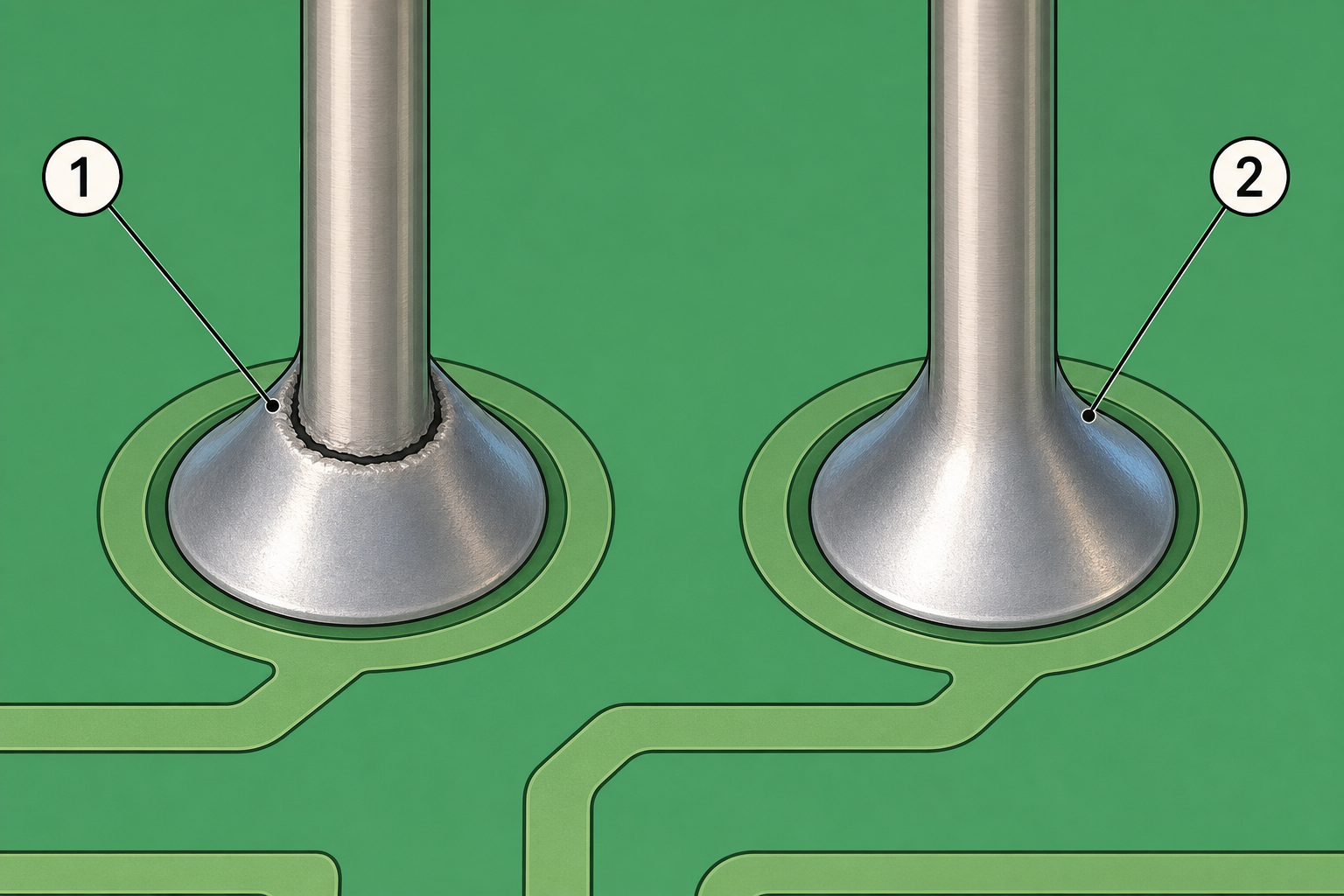
Close-up of the failure mode: (1) a hairline solder crack — a ring fracture around the pin; (2) a good joint for contrast.