Informasjon om hjuloppheng og oppgraderinger
Omfattende guide til hjulopphengsdynamikk på 924/944/968, standard fjær- og stabilisatorspesifikasjoner etter modellår, tabell over torsjonsstengers fjærrater, og foreslåtte oppsett for gate-, gate/bane- og banebruk.
KJØREBALANSE
Velg kjøreegenskapen du vil justere bort for å hoppe til korrigeringene.
For fabrikkens spissing-, camber- og caster-verdier og toleransene deres, se 944 hjulstillingsverdier.
Hjulopphengsdynamikk
For å optimalisere hjulopphengets ytelse er det avgjørende å forstå overstyring og understyring, og hva som forårsaker dem.
Vektoverføring og grep
Under hard kjøring i sving forskyves vekt fra de indre til de ytre hjulene. Jo mykere hjulopphenget er, desto mer vekt overføres. Et perfekt nøytralt oppsett overfører like stor andel av vekten til både fremre og bakre ytre dekk, slik at begge mister grep samtidig på grensen.
Understyring
Hvis mer vekt forskyves til det ytre bakre dekket enn til det ytre fremre dekket under svingkjøring, har bakenden mer grep og fronten mister grep først. Bilen styrer en videre bue enn tiltenkt — dette er understyring (også kalt «push»). Føreren føler at bakenden prøver å skyve bilen ut av den tiltenkte linjen.
Overstyring
Hvis mer vekt forskyves til det ytre fremre dekket, har fronten mer grep og bakenden mister grep først. Bilen roterer mer enn tiltenkt inn i en strammere bue — dette er overstyring (også kalt «loose»). Dette er en selvforsterkende tilstand: mer overstyring øker svingkraften på de ytre hjulene, som skyver bakenden nærmere utbrudd. Uten korreksjon eskalerer situasjonen til bakenden mister grepet helt og bilen spinner.
944, som de fleste serieproduserte biler, er konstruert med en grad av understyring fordi en bil som understyrer forblir stabil i en panikksituasjon, mens en bil som overstyrer eskalerer mot spinn.
Slippvinkel
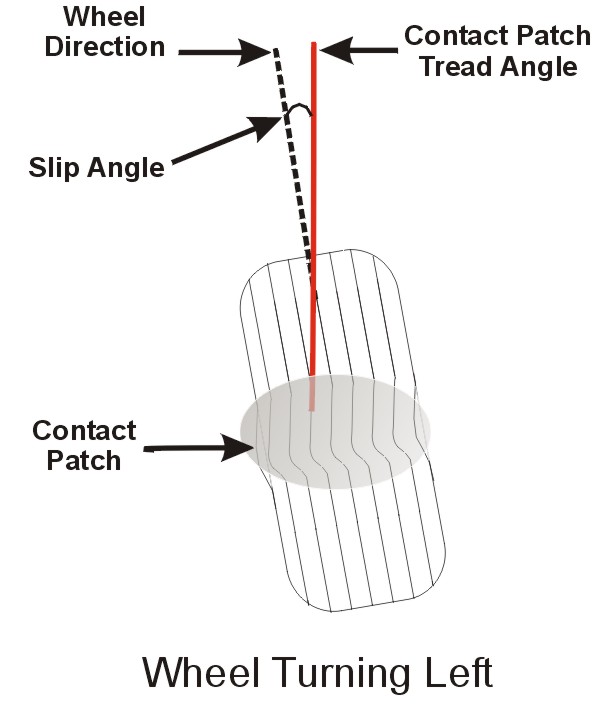
Slippvinkel er den vinkelmessige forskjellen mellom retningen dekkets kontaktflate peker og retningen hjulet er styrt. Tyngre belastning på et dekk øker slippvinkelen. Når de bakre dekkenes slippvinkler overstiger de fremre, blir resultatet overstyring; når de fremre overstiger de bakre, understyring.
Effekter av akselerasjon og bremsing
- Akselerasjon (bakhjulsdrift): Trekkraften ved de bakre dekkene øker bakre slippvinkel, og fremkaller overstyring fra et nøytralt oppsett.
- Bremsing: Vekt forskyves forover, noe som øker fremre slippvinkler, som fremkaller overstyring (bakenden glir ut). Plutselig gasslipp i en sving har lignende effekt.
Ideelt oppsett
Den ideelle hjulopphengsresponsen er ikke én enkelt oppførsel, men en blanding gjennom svingen:
- Akselerasjon i rett linje: lett understyring, som holder bilen stabil og krever få korreksjoner for å holde rett kurs.
- Sving-inngang: lett understyring igjen, for å holde bilen stabil mens bremsene slippes og svingkreftene bygger seg opp.
- Apeks: nøytral, slik at svinggrepet er på sitt maksimale og bilen kan drifte gjennom hvis du kommer inn litt for hardt, i stedet for at fronten eller bakenden mister grepet midt i svingen.
- Sving-utgang: lett overstyring, for å la bilen ta en strammere bane ut av svingen.
Korrigering av kjøreegenskaper
Hvis bilen skyver ut (understyring) eller bakenden går ut (overstyring), lister tabellene nedenfor justeringene du kan endre i hver ende av bilen. Endre én ting om gangen og test på nytt — både fremre og bakre justeringer flytter balansen, så du trenger sjelden alle.
Redusér understyring (bilen skyver ut)
| Understyringskorrigering — front | Understyringskorrigering — bak |
|---|---|
| Mykere fremre fjærer | Stivere bakre fjærer |
| Tynnere eller ingen fremre stabilisator | Bakre stabilisator eller tykkere |
| Øk fremre dekktrykk | Senk bakre dekktrykk |
| Mykere fremre støtdempere | Stivere bakre støtdempere |
| Mer negativ camber foran | Mer positiv camber bak |
| Fjern vekt foran | Legg til vekt bak |
| Mer nedpress foran | Mindre nedpress bak |
| Bredere dekk foran | Smalere dekk bak |
| Mer positiv caster | Sperredifferensial bak eller stivere bakdiff |
Redusér overstyring (bakenden går ut)
| Overstyringskorrigering — front | Overstyringskorrigering — bak |
|---|---|
| Stivere fremre fjærer | Mykere bakre fjærer |
| Fremre stabilisator eller tykkere | Tynnere eller ingen bakre stabilisator |
| Senk fremre dekktrykk | Høyere bakre dekktrykk |
| Mer positiv camber foran | Mer negativ camber bak |
| Legg til vekt foran | Fjern vekt bak |
| Mindre nedpress foran | Mer nedpress bak |
| Smalere dekk foran | Bredere dekk bak |
| Stivere fremre støtdempere | Mykere bakre støtdempere |
Standard hjulopphengsspesifikasjoner
Tabellen under viser fabrikkens fjær-, stabilisator- og torsjonsstangspesifikasjoner etter modellår. M030 sport-hjulopphengspakken er angitt separat der det er aktuelt. Data hentet fra en hjulopphengsartikkel i magasinet Excellence av Jim Pasha, supplert med informasjon om torsjonsstengers fjærrate.
| År/modell | Fremre fjær | Fremre stabilisator | Bakre torsjonsstang | Torsjonsstangrate | Bakre stabilisator |
|---|---|---|---|---|---|
| 1976–1977 924 | 140 lb | 21 mm | 22 mm | 97 lb/in | 18 mm |
| (merk: stabilisatorer var ekstrautstyr disse årene; standardmodeller hadde ingen) | |||||
| 1978 924 | 140 lb | 22 mm | 22 mm | 97 lb/in | 14 mm (ekstra) |
| 1979 924 | 140 lb | 23 mm | 22 mm / 23,5 m/bak stab. | 97 lb/in / 126 lb/in | 14 mm (ekstra) |
| 1980 924/Turbo | 140 lb | 21 mm | 22 mm / 23,5 m/bak stab. | 97 lb/in / 126 lb/in | 14 mm (ekstra) |
| 1981 924/Turbo | 140 lb / 160 lb m/M471 | 21 mm / 23 mm m/M471 | 23,5 mm | 126 lb/in | 14 mm (ekstra) |
| 1982–1985 924 (fra sept. 1981) | 140 lb | 20 mm / 21,5 ekstra | 23,5 mm | 126 lb/in | 14 mm (ekstra) |
| 1982–1984 944 | 160 lb | 20 mm / 21,5 ekstra | 23,5 mm | 126 lb/in | 14 mm (ekstra) |
| 1985–1986 944/924S | 2946 N | 20 mm | 23,5 mm | 126 lb/in | 14 mm (ekstra) |
| (M030 ekstra) | 2698 N | 21,5 solid eller 23×3,5 hul | |||
| 1987–1989 944/924S | 2946 N | 21,5 mm | 23,5 mm | 126 lb/in | 18 mm (ekstra) |
| (M030 ekstra) | 3050 N | 25,5×4 hul | |||
| 1987–1988 944S | 3535 N | 21,5 mm | 23,5 mm | 126 lb/in | 18 mm |
| (M030 ekstra) | 3286 N | 23 mm hul | 25,5 mm / 25,5 hul | 175 lb/in / 149 lb/in | 20 mm (ekstra) |
| 1985–1991 944T | 3286 N | 22,5 mm | 23,5 mm | 126 lb/in | 18 mm |
| (M030 ekstra) | 3250 N | 24 mm hul | 25,5 mm | 175 lb/in | 18 mm |
| 1987+ 944T (M030 ekstra) | 25,5 mm hul | 26,8 mm hul | 175 lb/in | 16 mm | |
| 1989–1991 944S2 | 3250 N | 26,8 mm hul | 24 mm | 137 lb/in | 16 mm |
| (M030 ekstra) | 3120 N | 25,5 mm | 16 mm | ||
| 968 | 3250 N | 26,8 mm hul | 24 mm | 137 lb/in | 16 mm |
| 968 (M030) | 30 mm hul | 19 mm (3-veis just.) |
Merk om enheter for fjærrate: Rater oppgitt i lbs er ukomprimerte fjærrater; rater oppgitt i Newton gjelder fjærer komprimert til normal driftshøyde. Disse er nyttige for å sammenligne ett kjøretøy med et annet, men ikke for absolutt sammenligning av fjærstivhet uten et felles referansepunkt.
Torsjonsstengers fjærrater etter diameter
Følgende gjelder solide torsjonsstenger. For hule stenger, innhent fjærraten fra produsenten.
| Diameter (mm) | Fjærrate (lb/in) |
|---|---|
| 22,0 | 97 |
| 22,5 | 106 |
| 23,0 | 116 |
| 23,5 | 126 |
| 24,0 | 137 |
| 24,5 | 149 |
| 25,0 | 161 |
| 25,5 | 175 |
| 26,0 | 189 |
| 27,0 | 220 |
| 28,0 | 254 |
| 29,0 | 292 |
| 30,0 | 335 |
| 31,0 | 382 |
| 32,0 | 434 |
| 33,0 | 490 |
Retningslinjer for hjulopphengsoppsett
Prinsipper
Å bytte til høyere fjærrater for fremre fjærer, torsjonsstenger og stabilisatorer reduserer karosserikrengning, forbedrer dekkontakt under svingkjøring, reduserer squat under akselerasjon og reduserer dykk under hard bremsing.
Den maksimale standard fremre fjærraten i 924/944/968-serien er omtrent 175 lb/in. En fjær over 175 lb/in forbedrer kjøreegenskapene utover standard.
- Gatekjøring: fjærrater fra 200–220 lb/in gir god forbedring
- Gate med sporadisk banebruk: 250–275 lb/in er et utmerket valg
- Kun bane (944 Turbo Cup-referanse): 375–410 lb/in fjærer med progressiv rate — for harde for gatebruk
Eksempeloppsett
Sportslig gateoppsett
Et godt utgangspunkt for en hovedsakelig gatekjørt bil:
- Fremre fjærer: 220 lb/in
- Bakre torsjonsstang: 27 mm (nøytral styring)
- 26 mm for mer understyring
- 28 mm for mer overstyring (vis forsiktighet — overstyrende biler er mer krevende å kontrollere i nødsituasjoner)
- Fremre stabilisator: 30 mm
- Bakre stabilisator: 19 mm (968 M030 3-veis justerbar stabilisator er et utmerket valg da den gir ekstra tuningspenn)
Ytelsessterkt gate-/baneoppsett
- Fremre fjærer: 260 lb/in
- Bakre torsjonsstang: 28 mm (nøytral)
- 27 mm for mer understyring
- 29 mm for mer overstyring
- Fremre stabilisator: 30 mm
- Bakre stabilisator: 19 mm
Fullt baneoppsett
Ikke anbefalt for gatebruk:
- Fremre fjærer: 400 lb/in
- Bakre torsjonsstang: 31 mm
- Fremre stabilisator: 30 mm
- Bakre stabilisator: 19 mm
Tilleggsmerknader
- Å indeksere torsjonsstenger for å endre kjørehøyde er tidkrevende og kan kreve flere forsøk over flere dager for å la hjulopphenget sette seg (se SUSP-06).
- Et alternativ er å konvertere til coilover-støtdempere bak, og dermed eliminere torsjonsstengene helt. Dette er dyrere, men unngår reindeksering.
- En hybridtilnærming bruker eksisterende torsjonsstenger kombinert med bakre coilover-støtdempere for å oppnå en bestemt fjærratebalanse. Dette krever coilovere med justerbare fjærseter for kontroll av kjørehøyden.
- Justerbare støtdempere og fjærbein er en verdifull oppgradering selv for gatebruk. Koni Sport er en foretrukket støtdemper/fjærbein her, med Bilstein som et godt alternativ. For banebruk er et fullt coilover-oppsett på alle fire hjørner det mest fleksible alternativet.
Vær klar over at ingen to biler vil reagere identisk på de samme komponentendringene, og ingen to førere vil ha samme følelsespreferanser. Oppsettene over fungerer som utgangspunkt for en omtrent nøytral kjørekonfigurasjon. Finjustering via justering av støtdemperstivhet, camber, caster og dekktrykk kan stille inn den nøyaktige følelsen man ønsker.