Oil Pan Gasket Replacement
Complete procedure for replacing the 944 oil pan gasket, including front suspension cross-member drop, engine support requirements, sealant guidance, torque sequences and specs, and turbo-specific intake/cross-over pipe steps.
Introduction
Replacing the oil pan gasket on a 944 ranks as one of the more demanding jobs on the car. Despite appearing simple on the surface, it requires dropping the front suspension cross-member — which requires supporting the engine from above. On turbocharged cars, the cross-over pipe must also be removed, which requires removing the intake manifold.
Plan on approximately 8–10 hours on a normally-aspirated 944 and 12–14 hours on a turbocharged car.
When replacing the oil pan gasket, it is also an excellent time to replace the rod bearings.
Sealant Note
Porsche Technical Bulletin No. 9005 recommends Silastic RTV 730 sealant at the inside and outside corners of the oil pan gasket. Silastic 730 is rated for high-temperature oil environments. A suitable alternative is Permatex Ultra Grey (an oil- and fuel-resistant RTV sealant). A colleague who never uses any sealant at all on the pan gasket reports no early returns with pan leaks. The key point: use the correct type of sealant, or use nothing at all. Do not use sealants that are not oil-resistant.
Tools
- Metric wrench set
- Metric socket set
- Silastic RTV 730 (000 043 019 00) or suitable high-temperature oil-resistant RTV
- Floor jack
- Jack stands
- Engine hoist, factory engine support (VW 10-220 or VW 10-220A), or fabricated equivalent
- Tie rod separator
- Catch rags
- Catch pan
- Torque wrench
Note: If an engine hoist or factory support tool is not available, it is possible to fabricate a support bar to hold the engine from above. The factory tool (VW 10-220) spans the engine bay and supports the engine via the lifting points.
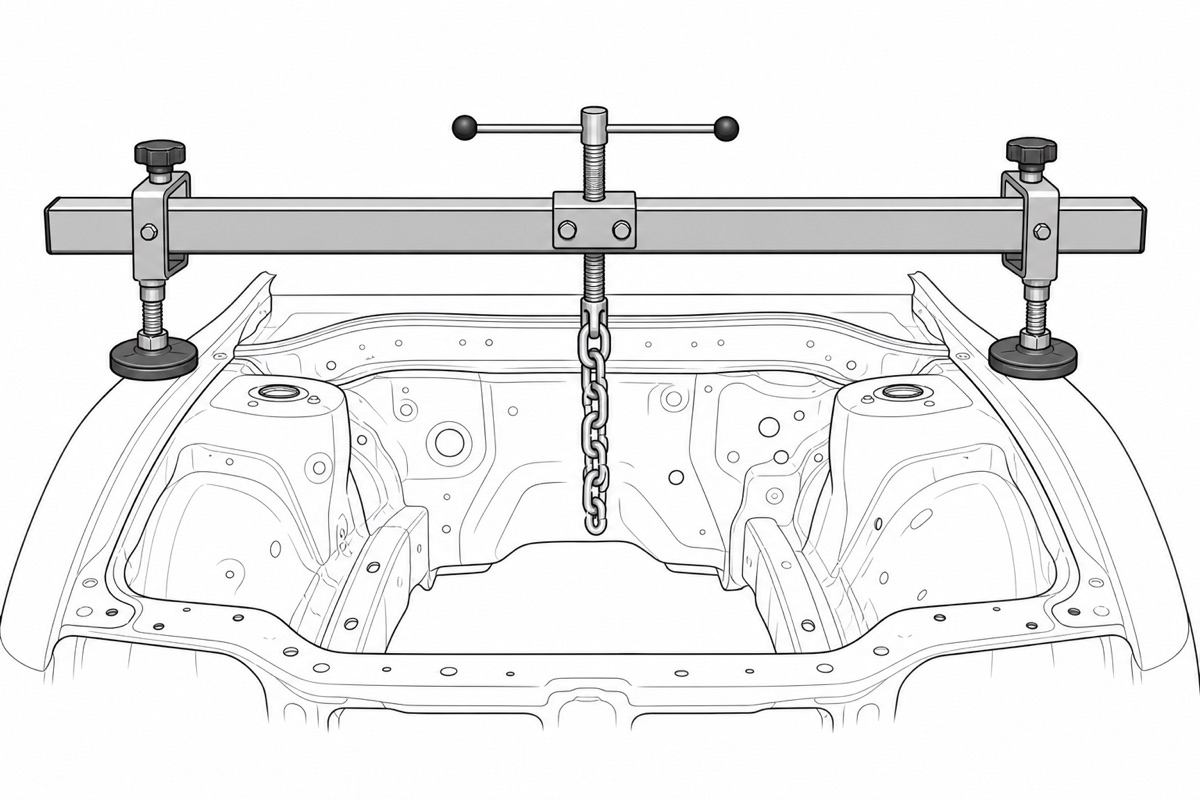 An engine support bar rests across the wing edges and holds the engine from above by a central hook, freeing the cross-member to be dropped.
Parts
| Part Number | Description | Model | Year |
|---|---|---|---|
| 944 101 205 02 | Oil Pan Gasket | 944 / 944S / 944S2 / 944 Turbo / 968 | All |
Other Procedures Needed
- FUEL-02, Fuel Injector and Fuel Rail Removal and Installation (Turbo only)
- FUEL-09, Intake Manifold Removal and Installation (Turbo only)
- EXH-01, Exhaust System Removal and Installation
Procedure
- Disconnect the battery positive lead.
- Place the vehicle on jack stands.
- Drain the oil from the pan.
- On turbocharged cars: a. Using FUEL-02, remove the fuel rail and injectors. b. Using FUEL-09, remove the intake manifold. c. Using the applicable section of EXH-01, remove the turbo cross-over pipe.
- Remove the front stabiliser bar assembly-to-chassis (drop link) bolts and control arm bolts, and remove the stabiliser from the vehicle.
- Disconnect the steering tie rod ends. A gear-puller type separator is preferable to a fork/splitter type — it disconnects the tie rod ends without damaging the boots.
- Place alignment marks on the splined input shaft of the steering rack and on the universal joint on the steering shaft (punch marks or brightly-coloured paint) so they can be reassembled in the same orientation.
- Disconnect the steering gear shaft using a punch and hammer. Do not damage the splines.
- Remove the bolts that attach the suspension control arms to the chassis.
- Disconnect the ball joints that hold the steering knuckles to the control arms.
- Remove the bolts in the top of the motor mounts that hold the motor mount to the motor mount bracket.
- If equipped with power steering, disconnect the power steering rack lines at the pump. Have a catch pan and rags ready. Wearing gloves is advisable.
- Support the cross-member using a floor jack and a piece of wood.
- Support the engine from above using the appropriate tool.
- Remove the four cross-member-to-body bolts. Leave the steering rack and stabiliser bar attached to the cross-member and lower the entire assembly (including the control arms) from the vehicle. This should provide enough clearance to remove the oil pan.
- Remove the 22 oil pan retaining bolts (10 mm).
- Remove the oil pan. A small pry tool may be needed to break the seal between the pan and crankcase.
- Inspect the inside of the crankcase from below. This is an opportunity to replace rod bearings if planned. Check the oil pickup tube: it must be completely intact (no cracks), firmly mounted, and the screen at the bottom should be clean.
- Clean and inspect the oil pan. Remove any debris and determine whether it indicates engine or bearing damage (metal filings, etc.).
- Remove the old oil pan gasket from the pan and install the new gasket. Apply appropriate sealant to the corner areas of the gasket. A small amount of trim adhesive on the very outside edge of the gasket can help hold it in position during installation — do not use too much and keep adhesive away from the sealing area.
Note: Strictly adhere to the torque specs and sequence below. Do not overtorque the oil pan bolts.
- Install the pan onto the crankcase with the mounting bolts but do not fully tighten. Once all bolts are installed, tighten in sequence:
- Step 1: install all bolts
- Step 2: torque to 4 N·m3 ft·lb
- Step 3: torque to 8 N·m6 ft·lb
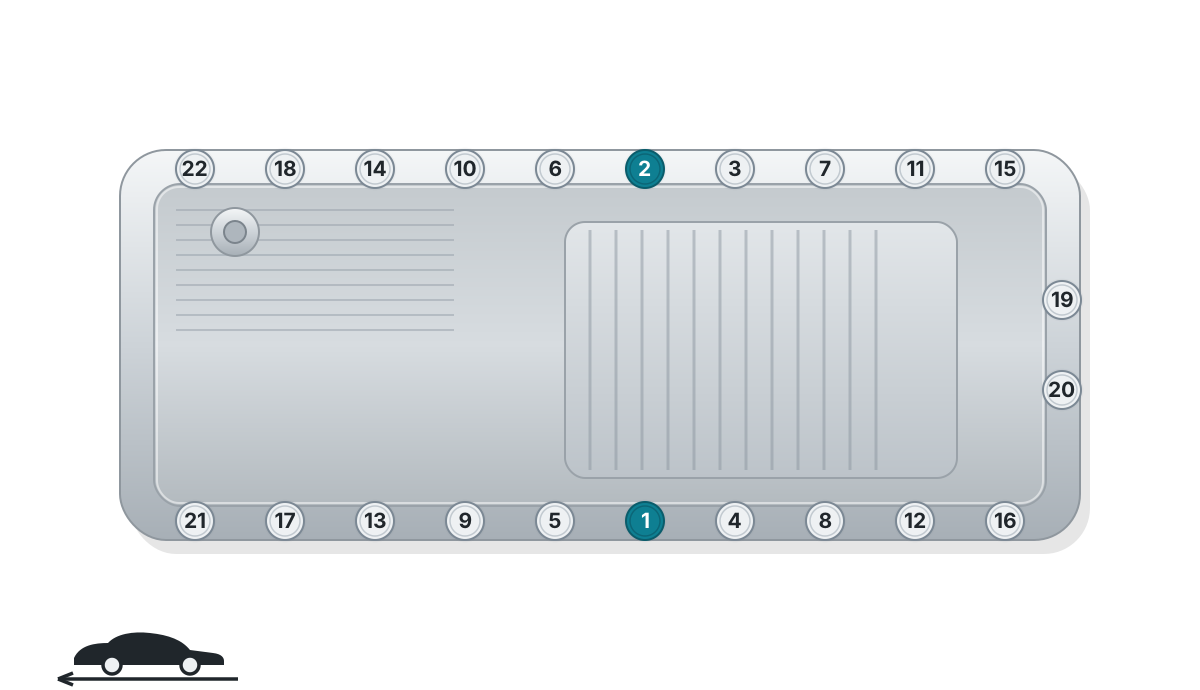 Oil-pan bolt tightening sequence (factory fig. 17-13): follow the numbers — begin at the two centre bolts (1, 2) and work outward, clockwise from inside to outside. The car symbol marks the front of the engine. See the fastener overview for the bolt spec.
- Raise the steering rack and cross-member assembly into position. As you raise it, align the motor mounts with the motor mount brackets and install the motor mount bolts (M8). Align the steering linkage splines using the alignment marks made during removal. When fully raised, install the four cross-member bolts (M12) and torque (19 mm socket) to 85 N·m63 ft·lb. Torque the motor mount bolts (13 mm socket) to 23 N·m17 ft·lb.
- Install and tighten the bolt holding the steering linkage to the steering rack splined shaft.
- Reattach the power steering rack hoses to the pump.
- Install the control arm-to-chassis bolts (M10) and torque to 46 N·m34 ft·lb.
- Attach the control arm ball joints (M10) to the steering knuckles and torque the lock nuts to 50 N·m37 ft·lb.
- Install the front stabiliser bar. Torque the stabiliser linkage-to-body bolts (M8) to 23 N·m17 ft·lb. Torque the stabiliser-to-control arm lock nuts (M8) to 23 N·m17 ft·lb for steel control arms or 25 N·m18 ft·lb for aluminium control arms.
- On turbocharged cars: a. Install the turbo cross-over pipe (EXH-01). b. Install the intake manifold (FUEL-09). c. Install the fuel rail and injectors (FUEL-02).
- Install the oil drain plug and fill the engine to the appropriate oil level.
- Connect the battery positive lead.
- Remove the vehicle from jack stands.